The challenge
A fragrance manufacturer wanted to understand which ingredients define each formula, reduce raw-material complexity without changing the scent, and adapt recipes quickly when regulations or supply change. The knowledge existed in ERP records and in the experience of the perfumers, but not in a form a computer could use.
Our approach
- Worked with the CEO, the Master Perfumer and the IT team to define the use cases and the validation rules.
- Converted complex ERP recipe records into a clean, machine-learning-ready dataset of formulations, ingredients and odour families.
- Trained and compared models that identify the ingredients carrying a formula’s identity and those that may be redundant.
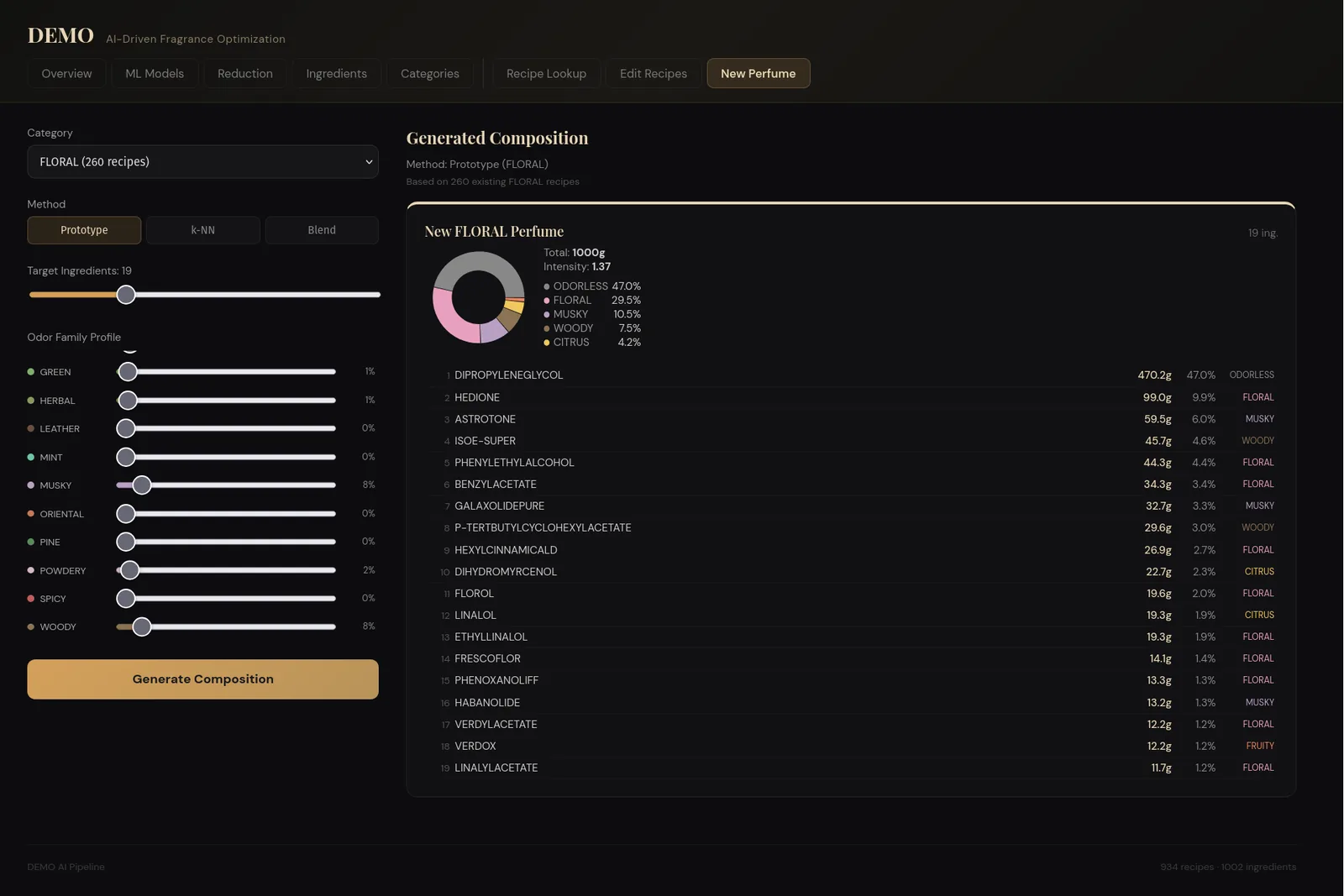
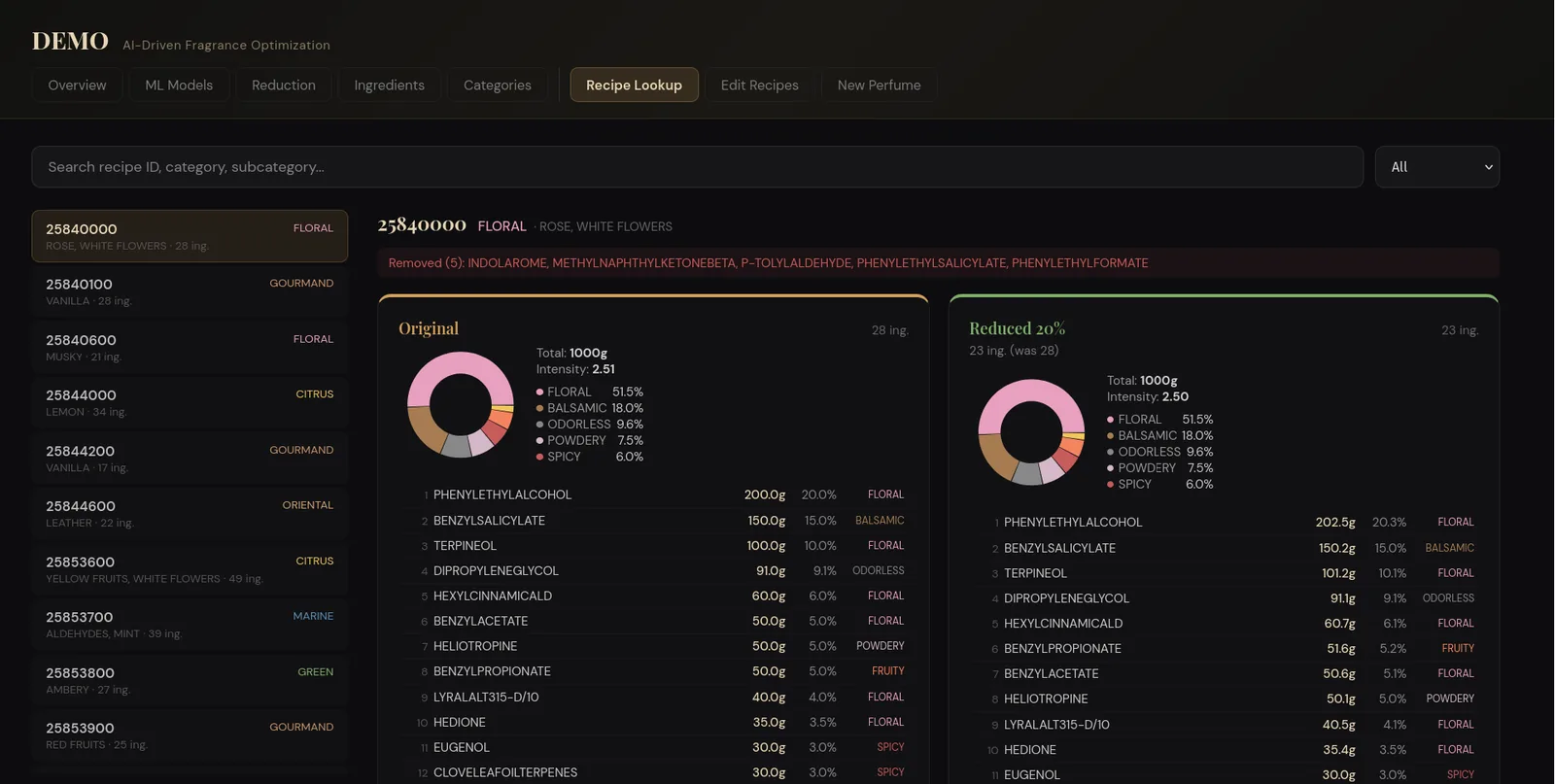
- Built AROMA AI, an interactive React / Node.js dashboard with KPIs, model comparison, reduction analysis and a recipe generator.
Results & features
- Proposes simplified formulas with 20–40% fewer ingredients while keeping the odour family and intensity within technical limits.
- Adapts formulas to new constraints, such as removing an ingredient for export regulations.
- Generates new compositions from a chosen ingredient count and target odour families. Every proposal remains subject to expert review and laboratory testing.
- The same approach applies to cosmetics and food, for raw-material cost, portfolio simplification and product development.